Nutrient Management for Livestock Farms
Nutrient management helps farmers make the most of manure, fertilizer, and soil nutrients while protecting water quality and supporting productive crops. UConn Extension works with dairy and livestock producers across Connecticut to improve nutrient management practices, balance nutrient applications with crop needs, and reduce nutrient losses from agricultural fields.
Led by Richard Meinert, UConn Extension's nutrient management work combines applied research, farm-based education, innovative technology, and collaboration with agricultural partners to address the challenges of managing nutrients on Connecticut farms.
Contact for More Information
Richard Meinert
(860) 626-6240
Litchfield County Extension Center
843 University Drive Torrington, CT 06790
Why Nutrient Management Matters
Manure and fertilizers provide essential nutrients for crop growth, but applying more nutrients than crops can use may increase production costs and contribute to environmental problems. Excess nitrogen can leach into groundwater, while phosphorus can move with runoff into streams and other surface waters, contributing to water quality concerns.
Effective nutrient management helps farmers:
- Match nutrient applications to crop needs and soil conditions.
- Make better use of manure as a source of crop nutrients.
- Reduce unnecessary fertilizer purchases and application costs.
- Minimize nutrient runoff and leaching.
- Maintain productive soils and protect water resources.
- Improve the efficiency and sustainability of farm operations.
Nutrient Management Planning
A nutrient management plan helps farmers determine how much manure and fertilizer are available, how much nutrients their crops need, and where those nutrients should be applied.
UConn Extension works with farmers to improve nutrient distribution across fields by considering soil test results, crop requirements, manure nutrient content, and field conditions. This approach helps direct nutrients to fields that need them while reducing the risk of overapplication.
Manure Management and Soil Testing
Manure can be a valuable source of nitrogen, phosphorus, and potassium for crop production. Its nutrient content varies with animal diets, bedding, storage, and handling practices, making soil testing and manure analysis important tools for making informed application decisions.
UConn Extension encourages farmers to use soil tests and manure analyses to guide nutrient applications, calibrate spreading equipment, and maintain accurate field records. These practices can help reduce fertilizer expenses while supporting crop productivity and protecting the environment.
Precision Nutrient Management
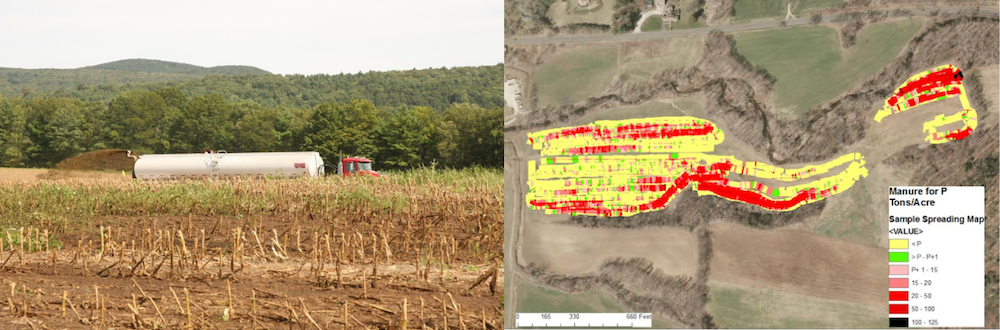
Connecticut farms often have small, irregularly shaped fields that present challenges for applying manure, lime, and fertilizer evenly. Equipment turning patterns, overlapping application passes, and variations in field shape can lead to uneven nutrient distribution.
UConn Extension is investigating ways to improve the accuracy of application maps and better understand where nutrients are distributed across fields. This applied research supports the development of tools and approaches that can help farmers target applications more effectively, reduce unnecessary overlap, and avoid adding nutrients to areas that already have sufficient levels.
Pasture and Livestock Systems
Nutrient management is closely connected to pasture health, grazing management, and livestock production. Appropriate nutrient distribution supports forage growth and helps farmers manage manure resources as part of an integrated farm system.
Through research, workshops, and educational resources, UConn Extension helps farmers and agricultural service providers explore the connections among soil health, pasture productivity, livestock nutrition, and sustainable nutrient management.
Resources and Additional Information
Explore these UConn Extension resources to learn more about nutrient management:
- Nutrient Management Planning — Learn how nutrient inventories and field-specific planning help farmers match nutrient applications to crop needs.
- Multi-Faceted Approach to Nitrogen Management — Read about research and collaborative projects focused on nitrogen management, water quality, and more accurate nutrient application.
- Tri-State SARE Project Resources — Explore webinars on nutrient management, pasture management, soil testing, and soil health.
- UConn Soil Nutrient Analysis Laboratory — Find information about soil testing services and how to submit samples.
Nitrate Toxicity in Drought Stressed Forage After the Drought
Nitrate accumulates in soils during times of drought due to microbial action. Microbes create the nitrate as normal byproducts of their metabolism. In soils with normal moisture levels the nitrate dissolves into the water and moves at relatively low levels in to the plants to be used to create protein. In dry soils the nitrate can’t move into the plant roots so it accumulates in the soil. When the rain finally falls this accumulated nitrate all dissolves into the dater at once. The plants need time to recover so the nitrate Nitrate moving into plants stressed by drought moves upward into the plants slowly. This recover process can take 3-5 days in grass species including corn). Since the nitrates are higher in lower portions of the plant if you are going to harvest immediately for feed raise your cutting height. This is especially important with corn silage if you intend to green chop to feed while harvesting corn. Nitrates in silage reduce 50 to 60 % in silage but it can take 3-4 weeks for levels to drop. For extremely browned out grass species – like a lot of hay fields, pastures and lawns this summer the brown stalks will not take up the moisture – they are dead and the capillaries needed to move liquid up the plant have broken and will no longer function. This means that the forage that springs out of the stems at the soil surface – all the “new growth” bright green grass will be what contains the high nitrate levels. For pastured animals you should move animals off the recovering pastures and keep them confined into winter feeding areas and keep feeding them stored feed until the new grass has a chance to grow, reestablish and metabolize the extra nitrate into plant protein before the animals graze it again.
You can test for high levels by sending a sample to a forage testing lab. Nitrate N (NO3-N) levels <1,000 ppm on a dry matter basis are considered safe. Nitrate between 1,000 – 1,700 should be left to mature in the field or left to cure on a silage pad before feeding out. Nitrate levels > ~ 2,000 can be acutely toxic and potentially lethal to livestock. There will likely be a run on the labs since drought has been widespread throughout the Northeast region, so keeping the animals off pasture, or waiting to harvest for a week or so might be the best way to manage the situation. For more in-depth information:
High Nitrate Potential in Corn Silage - Penn State Extension
Production and Harvesting - Penn State Extension
Precautions for Feeding Frosted and Drought-Stressed Forages - Ohio State Extension